
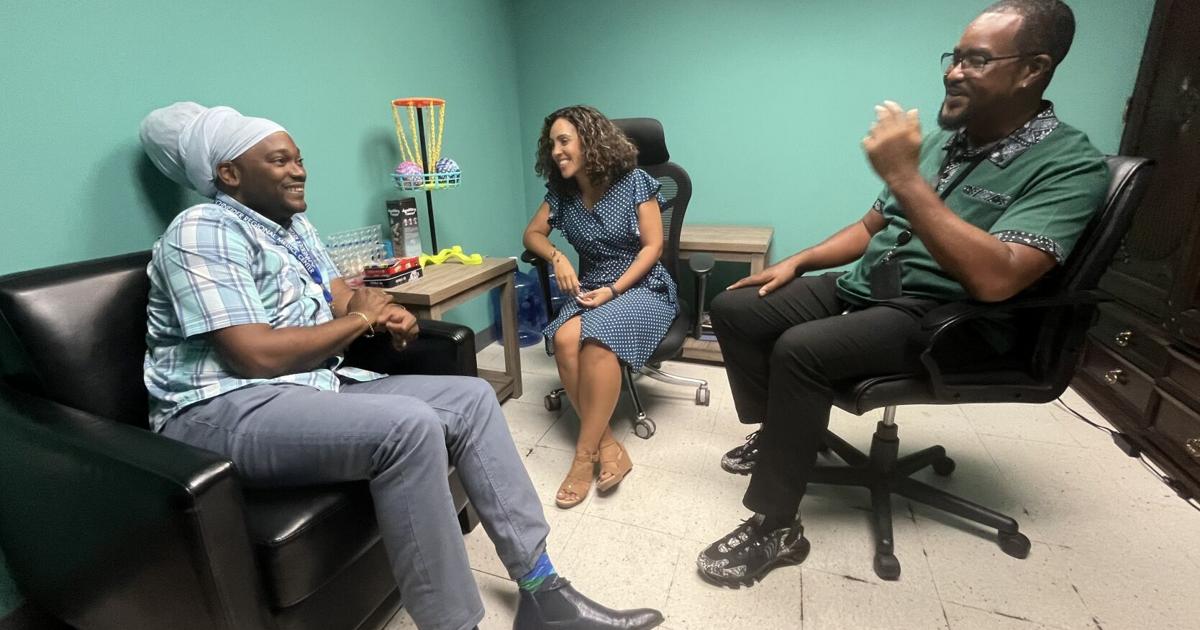
ST. THOMAS — Mental health support is available to all at the Wellness Center at Schneider Hospital, where therapists say they’re eager to assist everyone with navigating difficult stages of life.
“We’re here to help,” said Roland Riviere, center administrator and behavioral health therapist. “We don’t turn away anyone.”
Riviere said he’s treated clients as young as 5 years old, to those in their 80s, and everyone can benefit from therapy regardless of age or circumstance.
Outpatient behavioral health therapist Cynthia Portalatin agreed that therapy can provide tools to help individuals deal with negative experiences, and develop long-term coping strategies.
The community would benefit if “we would start considering mental health as part of preventative care,” she said. When individuals have a trusted therapist they can stay in contact with, then “you can kind of help people as they go through crisis.”
Many Virgin Islanders are facing pressures at school, at work, and at home, and therapy “could end up pausing a crisis before it happens,” Portalatin added.
Clinical psychologist Dr. Derron Ambrose joined the staff shortly after the Wellness Center opened in 2023, and said he’s already seen clients who experienced a positive result.
“For me, a big success for treatment is when you can see a patient from beginning to end,” Ambrose said.
One woman in her late 60s sought therapy for the first time after several people close to her died in quick succession, and Ambrose said she was able to work through her depression and find hope for the future.
He ran into her recently at the grocery store and “she was so jubilant, just so excited,” Ambrose said. “She was so happy that she had come here.”
With about 150 clients receiving therapy at the Wellness Center, Riviere said it’s not uncommon to encounter clients in public. And while he’s happy to greet everyone and show respect, he’s also discreet and conscious of patient privacy.
“We live in a small community,” Riviere said.
Patients may fear that “your business is just going to be on the street,” Portalatin said, but “that is not something that will happen here,” and the Wellness Center’s location at the back of the hospital near the emergency room means patients can enter discreetly and meet privately with their provider.
The Wellness Center is a safe, confidential space where clients can seek support from trained professionals, including those on Medicare and Medicaid who may not have access to private providers.
Telehealth services are also available, and St. John residents can also seek treatment both in-person or over the phone.
Because the Wellness Center is located in the hospital, Portalatin said they also have the ability to help clients transition to inpatient treatment if needed, and “we can navigate that all within this space.”
Riviere said staff can also help caregivers and family members identify issues as they develop, such as dementia, which can often begin manifesting as uncharacteristic anger or “difficult” behavior.
Anger, and behavioral issues can also be signs of underlying trauma, abuse, or other problems for children and teens.
While some young people may lash out when they’re struggling, others withdraw and become quiet and reserved, and parents shouldn’t hesitate to call for advice if they’re noticing something amiss, Riviere said.
Ambrose said “stigma” is still a barrier for some adults who could benefit from therapy, but Riviere said in his work in schools, children are not embarrassed to discuss seeing a therapist openly, and their goal is to normalize therapy and normalize “us as clinicians.”
All of the staff said they work hard to communicate with other agencies and nonprofits to ensure they’re connecting clients with additional assistance when possible.
But they also agreed that one of the biggest challenges is the lack of available resources, particularly when it comes to vulnerable patients who need the most help.
Ambrose said there are two vans sitting parked outside the hospital that were purchased for mental health services, but they need staff and funding to be able to actually provide mobile crisis intervention and treatment as intended.
V.I. Police are typically the first responders to a mental health crisis, and Ambrose said the territory could benefit from following the lead of states where teams of trained counselors and unarmed security are dispatched instead.
Experienced mental health professionals could respond and help de-escalate a situation “so nobody gets hurt, nobody gets killed,” Ambrose said.
Riviere said the interplay of substance abuse and mental health can complicate diagnosis and make it difficult to differentiate between a drug-induced psychosis and a psychiatric disorder. And some patients need long-term care of six months to a year — far more than the hospital’s limited inpatient unit can provide.
The Bureau of Corrections houses many detainees and prisoners with mental health needs, who receive medication and stabilization treatment behind bars.
“The prison might be the place that does it the best, in a sense,” Riviere said.
But transitioning out of incarceration is often difficult, and there are few options for those who need a higher level of care.
“We need more resources,” Portalatin said.
“Resources are limited, funding is limited,” Ambrose said.
The territory is in desperate need of a “forensic psychiatric hospital” where patients can receive care in a secure setting, separate from a prison or traditional hospital.
“That is what I think the Virgin Islands needs,” Ambrose said.
Streamlining the civil commitment process would help ensure patients receive inpatient care before their situation escalates, Riviere said. There is also confusion over which agency should initiate involuntary commitment, and “no one wants to take the lead on who is responsible.”
For many Virgin Islanders, everyday life can be a challenge, particularly at a time of heightened “climate anxiety” due to the lingering effects of the hurricanes, which can manifest as stress, depression, and other struggles, Ambrose said.
Ambrose said he frequently treats patients with a wide variety of concerns about everything from relationships and financial problems, to overcoming traumatic events.
“There’s so much generational trauma, sexual trauma in our community,” as well as gun violence, Portalatin said, and therapists are available to help deal with it all.
For parents and teachers, “we try to be as much of a support as possible,” and “they can call us, their students can come see us,” Portalatin said. “We’re very private, I feel that we’re a small oasis.”
Office coordinator Aneka Evans “is a miracle worker” and schedules appointments and navigates insurance challenges, Portalatin said, even checking in on clients to ensure everyone is receiving the help they need.
Ambrose said staff are also happy to go out into the community and speak at schools or other community groups.
Ambrose is currently the only psychologist on island, and former staff member Dr. Zen Meservy is no longer providing outpatient psychiatric services.
The hospital has rotating psychiatrists available for inpatient services, and Acting Chief Medical Officer Dr. George Rosenberg said they’re working to recruit another psychiatrist at the Wellness Center.
“I think anybody who’s lived in St. Thomas understands there’s a tremendous need for mental health therapy,” Rosenberg said. “There is no shame in seeking counseling,” and “almost everybody can use it at some point in their lives.”
The Wellness Center’s services provide critical community support, and “we want to keep it, we want to grow it, we want to make it stronger,” he added.
To schedule an appointment or learn more about the Wellness Center, you can walk in to the rear entrance of Schneider Hospital and ask to speak with office coordinator Aneka Evans; call 340-776-8311, extension 2163; or email [email protected].
link