


Watch: Newbury Park High seniors receive graduation yard signs, decals
Steve Lepire, principal at Newbury Park High School, waves to students as they get yard signs at the school parking lot. This one of the things the school is doing before graduation.
JUAN CARLO, VC Star
- Conejo Unified won a competitive $11.3 million grant to pay for five years of enhanced mental health services.
- The Trump administration says it is canceling what remains of the $1 billion in grant funds nationwide.
- Students in Newbury Park say their grant-funded wellness center has helped them socially and academically.
Over the past decade, as rates of depression and anxiety among young people have grown, it’s become common for public schools to offer on-campus mental health services.
The Conejo Valley Unified School District is among the leaders in Ventura County in this area, with 40 full-time mental health professionals and 40 more interns on staff, and “wellness centers” at all 27 schools. Last year, more than 1,800 of the district’s 16,000 students received individual or group therapy, with their parents’ consent and at no cost to the families.
Most of the funding for those services is now under threat by President Donald Trump’s administration. On April 29, the U.S. Department of Education sent letters to hundreds of school district — including Conejo Unified — telling them it had “determined not to continue” their funding under a $1 billion mental health grant program passed by Congress and signed by President Joe Biden in 2022.
The school grants were part of a law written in reaction to the deadly school shooting that year in Uvalde, Texas. That law, the Bipartisan Safer Communities Act, included measures related to both gun control and mental health, and was the only significant federal legislative response to any school shooting in recent decades.
The grant was competitive, and Conejo Unified was the only school district in Ventura County to receive it. It now stands to lose nearly $5 million if what remains of its grant is canceled. The district was awarded $11.3 million to fund mental health services for a period of five years, from 2023 through 2027.
The Department of Education’s letter to Conejo Unified said the cancellation will take effect “at the end of your current grant budget period,” which is the end of the current calendar year. After that, if the district wants to avoid cuts to its mental health services, it will have to find other grants, state funding sources or move funds from elsewhere in its budget.
The federal government’s letter said the grant will be canceled because it “provides funding for programs that reflect the prior Administration’s priorities and policy preferences and conflict with those of the current Administration” and is “inconsistent with, and no longer effectuates, the best interests of the Federal Government.”
Heather Chamberlin-Scholle, Conejo Unified’s director of mental health and wellness services, said the district has heard nothing from the federal government outside of that letter, which appears identical to the ones sent to other school districts.
The letter lists a few reasons for canceling the grants: the grant-funded programs “violate the letter or purpose of federal civil rights law”; they conflict with the department’s policies “prioritizing merit, fairness, and excellence in education”; and they “undermine the well-being of the students those programs are intended to help.” Or, the letter states, they “constitute an inappropriate use of federal funds.”
Chamberlin-Scholle said she isn’t sure what the Department of Education’s letter is referring to in most of those areas. She suspects that the parts about civil rights law and “merit, fairness and excellence in education” might relate to the district’s efforts to hire an ethnically diverse group of therapists and interns. That’s something that was required in the application process for the grant, she said.
“One of the grant’s goals is to improve the diversity of our providers,” Chamberlin-Scholle said. “As clinicians, we are always trying to match providers with students based on their needs. For example, we have Spanish-speaking providers who can talk to our Spanish-speaking students. … At the end of the day, it depends upon the skill of the clinician, but sometimes it is very beneficial to have a clinician whose ethnicity is the same as yours.”
The Department of Education’s letter says that grant recipients “may request reconsideration of this decision,” by appealing in writing to an acting assistant secretary in the department. Chamberlin-Scholle said Conejo Unified plans to appeal.
“I’m just hoping that by painting the picture of how many kids we’re helping, we will hopefully get someone’s attention,” she said.
After pandemic, ‘students didn’t know how to interact’
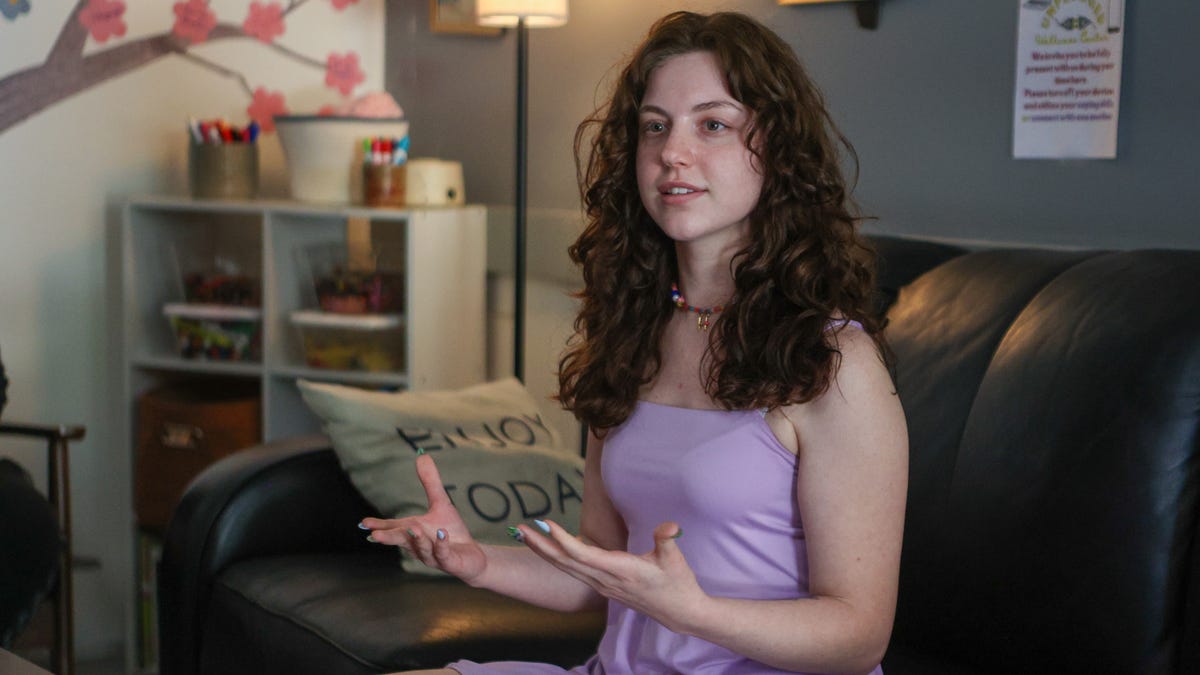
Harper Wilson, a senior at Newbury Park High School, is one of the kids who’s been helped by the grant. She started visiting the wellness center as a freshman, when schools were just returning to full-time in-person classes after the COVID-19 campus shutdown.
The next year, she helped start the student Wellness Club, and she’s now its president.
“I’ve found the resources here to be extremely helpful,” she said. “I think there’s a lot of crossover for most people between social, academic and home issues. Being able to be here, where my counselors are on campus, it’s just a lot easier for them to relate to my academic and social issues.”
When Wilson started high school, the district didn’t have the federal mental health grant yet. Once it got that money, Newbury Park High was able to move its wellness center out of a small room next to the library and into a much bigger space, with a central room for hanging out and talking and two smaller rooms for individual therapy sessions or for students to get some time alone.
The new wellness center is crowded at lunchtime, when it becomes a popular spot to drop in and hang out. If students would like to visit during class time, either for therapy or just a “mental health break,” they can get a pass from their teacher, said Tracey McTigue, Newbury Park High’s mental health clinician. About 20 or 30 students drop in every day, she said, and the center also has a regular caseload of more than 100 people who receive individual or group therapy.
The federal grant went to similar purposes in the rest of the district, helping schools expand their existing mental health programs. Before the grant, Chamberlin-Scholle said, 10 schools had wellness centers; now all 27 do. The grant also allowed the district to add 19 new positions, including 17 licensed mental health clinicians.
Like many other school districts, Conejo Unified had started expanding its mental health services in 2020 and 2021, using federal and state funds reserved for pandemic recovery. The need at the time was severe, said Steve Lepire, Newbury Park High’s principal.
“That whole socialization piece has been lost for a long time. Students didn’t know how to interact with each other, as opposed to looking at each other on a screen,” he said.
‘So many barriers’ to mental health treatment
As part of the grant process, the district has to keep track of the effectiveness of its programs. The district surveys students who receive therapy, and Chamberlin-Scholle said the results show “symptom reduction consistently, across the board.”
“This generation of kids, their mental health has been declining for a decade,” she said. “If you try to access services outside, it’s very expensive, and you have to hope someone is taking clients. There’s so many barriers, and so we just try to address the barriers and create a place where kids feel comfortable getting their mental health needs met.”
Matthew Larson, a Newbury Park High senior who has been visiting the school’s wellness center since he was a freshman, said the no-cost nature of the service is a big plus. He said he also feels “a lot more safe” talking to someone on campus, who specializes in talking to students.
“I feel like the context is a lot better, than going somewhere outside of school,” he said.
The federal grant doesn’t provide the entire budget for Conejo Unified’s mental health programs, but it does provide the vast majority. Chamberlin-Scholle said the district has two smaller state grants and is pursuing other sources of state funding.
One new state program allows school districts to be reimbursed by public or private insurance providers for mental health services provided at school. The program’s rollout has been slow.
News site CalMatters reported May 8 that only 14 school districts in the state have started billing insurers through the program, out of almost 500 districts that have signed up to participate.
Conejo Unified is one of the districts that has signed up. Chamberlin-Scholle said her hope is that the district can recover enough money to maintain a “sustainable” level of mental health services. She does not think the program can replace the $2 million-plus per year that the federal grant has provided.
Other districts do offer mental health services without federal grants. The Moorpark Unified School District has 14 full-time mental health counselors for about 6,000 students, and has wellness centers at all 10 of its schools, said Jane Wagmeister, the district’s assistant superintendent of instructional services, in an email interview. That’s similar to Conejo Unified’s ratio of providers to students.
The Moorpark district funds those programs through a variety of sources, including a grant directly from the state and a grant from the county that goes through the Ventura County Department of Education, Wagmeister said.
Without a dedicated source of funds like the federal grant, mental health programs are subject to the same uncertainty as any other district program if the budget gets tight. In Ventura, the school district put mental health positions on the chopping block when it was considering budget cuts in February, but the district’s board decided not to cut those positions.
‘It sends a pretty strong message’
Chamberlin-Scholle said the district’s first priority now is pursuing an appeal with the U.S. Department of Education. If that doesn’t work, there are legal avenues to pursue, and she said a number of local attorneys have already volunteered to help the district.
It’s not clear whether the president or an executive agency can legally stop funding a program that was funded by a bill signed into law by a previous president. Shortly after Trump took office in January, he attempted to freeze a wide array of federal grants, and he later rescinded that decision after a judge ruled against the administration.
But in other cases, courts have allowed the Trump administration to defund programs such as foreign aid.
Conejo Unified doesn’t have lawyers on staff, and right now it’s watching to see what other districts who have lost their mental health grants will do, and whether there will be a legal challenge.
“I think that in general, when you’re trying to make things happen, you’re stronger together,” said Kim Gold, a district spokesperson.
Wilson, the president of Newbury Park High’s student Wellness Club, said she thinks the campus wellness center and the club have done a lot to reduce the stigma around getting help, and she worries the federal government is trying to undo that work.
“The fact that this grant is being shut down, I think it sends a pretty strong message about the stigma around mental health,” she said. “It makes it seem like mental health is not being prioritized by our government.”
Tony Biasotti is an investigative and watchdog reporter for the Ventura County Star. Reach him at [email protected]. This story was made possible by a grant from the Ventura County Community Foundation’s Fund to Support Local Journalism.
link